Project 1: Ultralight Solid-State Single-Photon LiDAR
Lightness opens new frontiers.
Light detection and ranging (LiDAR) systems inherently involve performance trade-offs, where achieving precise measurement has traditionally required accepting weight and complexity.
When precise sensing and ultralight design coexist, LiDAR opens the door to entirely new applications.
Swipe to explore →
Episode 1: Information Carried by a Photon
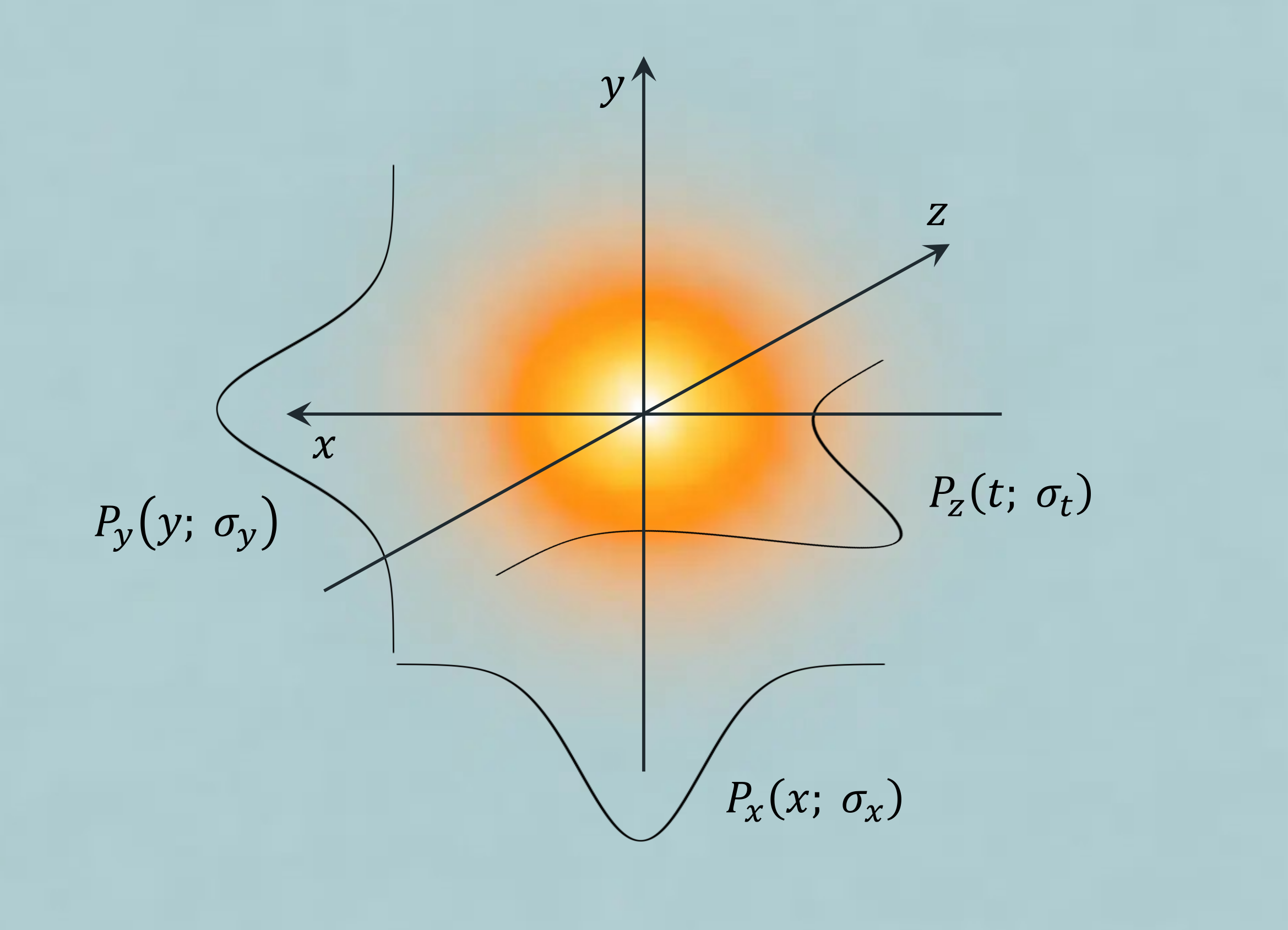
A single photon carries precise spatial and temporal information.
The spatial distribution in the x and y directions is defined by the diffraction limit of a Gaussian beam. Shorter wavelengths exhibit reduced divergence, making the near-infrared region well suited for practical systems.
The temporal dimension, t, is defined by the laser pulse itself. Precise timing demands both a short pulse width and a cleanly suppressed tail. Under laser safety constraints, pulse durations on the order of 10 to several tens of picoseconds are optimal. In 10 picoseconds, light travels only 0.3 mm.
In time-of-flight (ToF) measurements, even a single photon inherently carries sufficient spatial resolution in x, y, and z. The challenge has been integrating the laser source, beam scanning, single-photon detection, and picosecond-precision time measurement into a compact, practical system.
Episode 2: Tail-Free Picosecond Pulsed Semiconductor Laser
Self-terminating picosecond pulses — no tail.
At extreme carrier densities, bandgap renormalization (BGR) drives the gain medium into an electron–hole plasma (EHP), shifting the gain spectrum toward the lasing mode.
As carriers relax, the BGR effect diminishes, and the gain rapidly detunes from the lasing wavelength. Stimulated emission shuts off abruptly—well before carrier recombination completes.
The pulse, in effect, terminates itself.
Implemented in an edge-emitting laser (EEL), this mechanism delivers high-intensity picosecond pulses with a clean temporal profile and a diffraction-limited beam.
Episode 3: Uniform MEMS Scanning
Precise beam scanning fills space uniformly.
Uniform spatial coverage is achieved using a large-aperture two-dimensional micro-electro-mechanical systems (MEMS) mirror with a wide resonant bandwidth, driven by a digital feedforward control system. Operating at two frequencies selected within this resonant bandwidth, the mirror scans the laser beam across the field of view in a trajectory that progressively covers the entire area.
At the core of the digital driver is an up–down direct digital synthesizer (DDS), which accurately generates monotonically varying arbitrary waveforms, enabling precise control of the scanning trajectory.
Episode 4: Noise-tolerant Picosecond Time-to-Digital Converter
Picosecond timing from locally differential, noise-robust dynamics.
Pulse-shrinking gated buffering (PSGBR) is a time-amplification technique for measuring extremely small time intervals. The method exploits the difference in gate widths between closely placed pulse-shrinking (PS) pairs.
Because the differential behavior of these pairs is highly robust against process variations and supply fluctuations, PSGBR enables picosecond-level timing precision with excellent noise tolerance.
Reference
Ohno, T., Utagawa, Y., Tanabe, M. et al. Super-dense point clouds acquired by an ultralight 10 g solid-state single photon LiDAR. Nat Commun 16, 11567 (2025). https://doi.org/10.1038/s41467-025-67346-8